
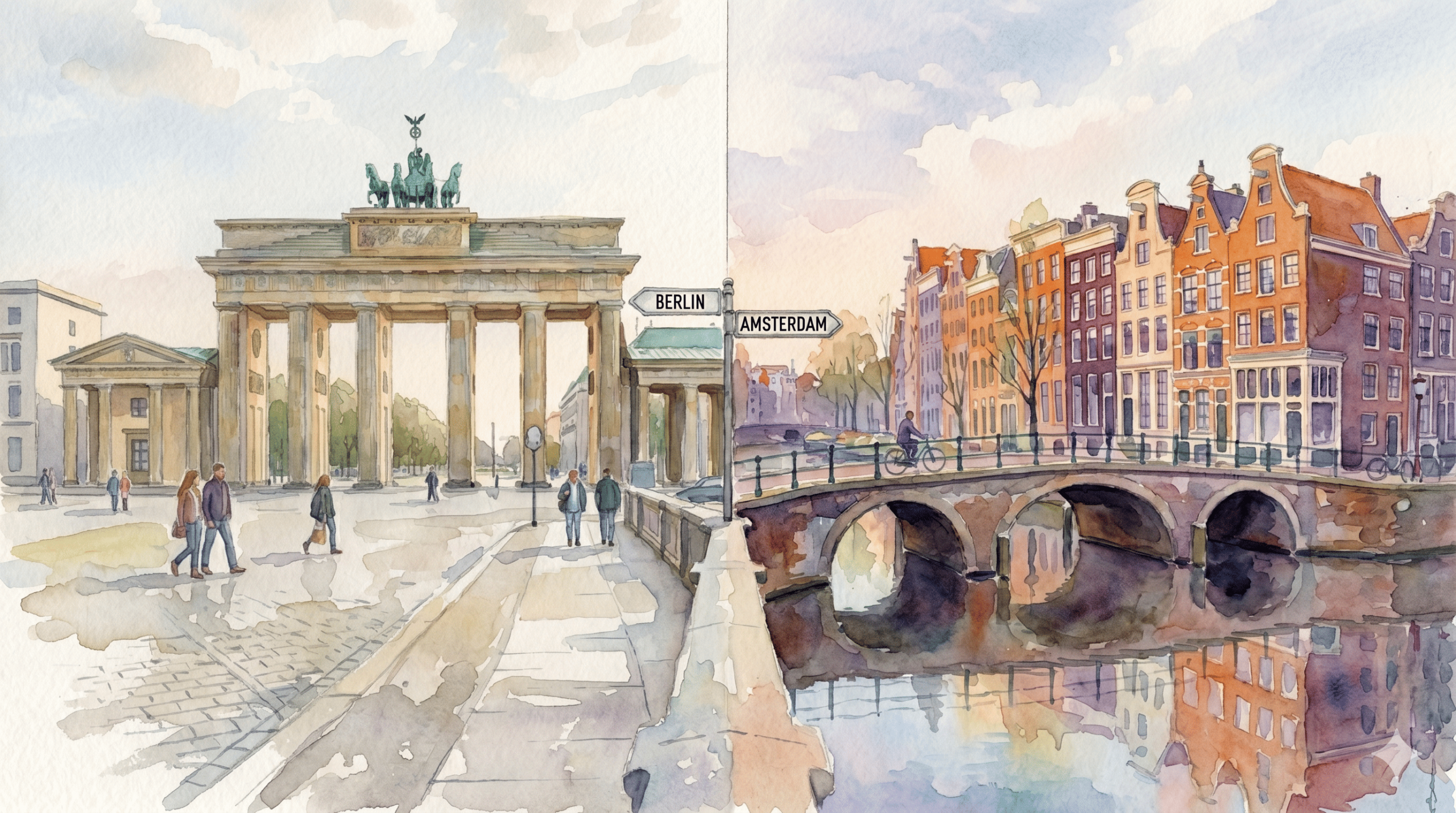
berlin vs amsterdam, which one is more expat friendly

Let’s skip the romanticized tourism brochures. Moving across borders is expensive and administratively exhausting. If you are relocating in 2026, you need raw data, not sugar-coated opinions. The European real estate market has officially stabilized after the interest rate shocks of previous years, but the financial realities of these two capitals remain starkly different.

Today, Amsterdam will give you a softer landing and higher net pay, especially if you qualify for the famous 30% tax ruling. However, it will absolutely brutalize your wallet when it comes to rent and property prices, with average residential units soaring to around €9,100 per square meter. Berlin, on the other hand, offers a much more realistic path to homeownership with average condo asking prices sitting at €5,813 per square meter.

Here is the unfiltered, side-by-side reality of where your money actually goes based on the latest 2026 data. No middle ground. Just the clear winners.

Category
Berlin
Amsterdam
Winner
Rent Average asking rent for new leases: €15.80/m² Average unregulated rental rent: €28.53/m² Berlin
Buying property Average condominium asking price: €5,813/m² Average residential price: around €9,100/m² Berlin
Cost of living incl. rent Lower overall monthly cost base Around 26.2% more expensive than Berlin including rent Berlin
Rent pressure Very competitive, but new-contract rents remain materially lower Structurally tight market, average unregulated listing receives 25 responses Berlin
Local purchasing power Lower than Amsterdam on city-level purchasing power Around 11.2% higher local purchasing power than Berlin Amsterdam
Salaries Median gross monthly earnings for full-time employees: €4,190 Netherlands median gross salary: around €4,000/month, Amsterdam roles can pay more in international sectors Tie
Income taxes OECD tax wedge for average single worker in Germany: 49.3% OECD tax wedge for average single worker in the Netherlands: 35.9% Amsterdam
Expat tax advantage No direct equivalent to the Dutch 30% ruling Eligible expats may benefit from the 30% ruling, reducing taxable income Amsterdam
English-friendliness Germany ranks #4 globally for English proficiency Netherlands ranks #1 globally for English proficiency Amsterdam
Space for your money Better sqm-per-euro in both rental and purchase markets Less space per euro due to higher rent and purchase prices Berlin
Path to ownership More realistic for expats with mid-to-high income, especially compared with Amsterdam prices Possible, but entry prices are significantly higher Berlin
Overall expat value Stronger if your priority is affordability, space and long-term property potential Stronger if your priority is English convenience, tax efficiency and a softer landing Berlin

The rental market in 2026: what does your money actually buy?

For expats, the rental market is usually the first reality check. And in 2026, the difference between Berlin and Amsterdam is not subtle. Berlin is no longer “cheap” in the old sense, but compared with Amsterdam, your money still buys noticeably more space, more choice and a more realistic landing.

The key thing to understand is this: most online rent data reflects asking rents, not signed contracts. So the numbers below should be read as realistic market-entry benchmarks for expats searching on platforms like ImmobilienScout24, Wunderflats, HousingAnywhere, Pararius and Funda, not as official rent-index figures.

Berlin’s average online asking rent for new leases is now around €15.80/m², while Amsterdam’s unregulated rental market sits at €28.53/m². That alone explains why the same expat budget feels very different in the two cities. In Berlin, €1,500 can still put you into a decent furnished one-bedroom in Prenzlauer Berg, Kreuzberg or Charlottenburg. In Amsterdam, the same budget often pushes you toward smaller units, less central areas, or heavy competition.

Studio and 1-bed apartments: what expats are actually paying

Furnished studio / 1-bed benchmarks

Area Profile
Berlin
Amsterdam
Better Value
Prime central Mitte: €1,400 benchmark Jordaan / Canal Belt: €2,500+ benchmark Berlin
Popular expat-family Prenzlauer Berg: €1,300 benchmark De Pijp: €2,200 benchmark Berlin
Lifestyle / Nightlife Kreuzberg: €1,200 benchmark Oud-West: €2,100 benchmark Berlin
Professional / Corporate Charlottenburg: €1,200 benchmark Zuidas: €2,300 benchmark Berlin
Better-value creative Neukölln: €1,100 benchmark Amsterdam Noord: €1,700 benchmark Berlin

For Berlin furnished one-bedrooms, Wunderflats gives useful neighbourhood-level guidance: around €1,100 to €1,700 in Mitte, €1,050 to €1,550 in Prenzlauer Berg, €950 to €1,450 in Charlottenburg, €900 to €1,400 in Kreuzberg and €850 to €1,350 in Neukölln. For a screenshot-friendly article table, I would use the midpoint-style benchmarks above instead of ranges.

For Amsterdam, the cleanest current benchmark is Pararius’ Q1 2026 figure of €28.53/m² for Amsterdam’s unregulated rental market, with furnished homes in the Netherlands averaging €26.79/m² and Amsterdam remaining the most expensive city in the country. Investropa’s Amsterdam rent analysis places a typical 1-bedroom around €1,900, with De Pijp, Oud-Zuid, Jordaan and the canal belt at the expensive end, and Amsterdam Noord among the cheaper expat-relevant options.

Unfurnished studio / 1-bed benchmarks

Area Profile
Berlin
Amsterdam
Better Value
Prime central Mitte: €1,050 benchmark Jordaan / Canal Belt: €2,100 benchmark Berlin
Popular expat-family Prenzlauer Berg: €950 benchmark De Pijp: €1,900 benchmark Berlin
Lifestyle / Nightlife Kreuzberg: €900 benchmark Oud-West: €1,850 benchmark Berlin
Professional / Corporate Charlottenburg: €900 benchmark Zuidas: €2,000 benchmark Berlin
Better-value creative Neukölln: €800 benchmark Amsterdam Noord: €1,500 benchmark Berlin

The unfurnished numbers should be framed as asking-rent benchmarks for typical small apartments, not guaranteed deals. Berlin’s official rent index tells a very different story for existing tenancies, with a median net cold rent of €7.21/m², but new arrivals rarely access those older contracts. That is why expats should compare new-market asking rents, not legacy rents held by long-term tenants.

2 to 3-bedroom apartments: what couples and families are actually paying

This is where Berlin’s advantage becomes even more visible. For a couple or young family, the difference is not just €300 or €500 per month. It can be the difference between having a separate home office and eating dinner next to your laptop.

Household type
Berlin
Amsterdam
Better Value
Couple, 2-room / 1-bed furnished €1,400 to €1,800 €2,000 to €2,600 Berlin
Couple, 2-room / 1-bed unfurnished €1,000 to €1,400 €1,700 to €2,200 Berlin
Family, 2-bed furnished €1,800 to €2,600 €2,700 to €3,500 Berlin
Family, 2-bed unfurnished €1,500 to €2,200 €2,300 to €3,000 Berlin
Family, 3-bed in expat-friendly area €2,200 to €3,200 €3,200 to €4,500+ Berlin

A useful way to explain this to readers: Amsterdam may feel more international from day one, but Berlin gives families more breathing room. In Amsterdam, a 2-bedroom apartment is already a premium product. Investropa estimates the average Amsterdam 2-bedroom at around €2,850, while Berlin’s 2-bedroom benchmark is closer to €1,650 for a typical unfurnished unit.

Berlin vs Amsterdam: How competitive is the rental market?

Both cities are difficult. Amsterdam is expensive and structurally tight. Berlin is cheaper, but extremely frustrating because good apartments disappear fast and older affordable contracts almost never come back to the market.

Competition Factor
Berlin
Amsterdam
Winner
Online asking rents Lower Much higher Berlin
Competition for listings Very high Very high Tie
Time pressure Apply immediately Apply immediately Tie
Income requirements Often 3x net or strong proof of income Often 3x to 4x gross income Berlin
Furnished expat market Expensive, but still lower than Amsterdam Very expensive Berlin
Ease for English-only Medium High Amsterdam

Pararius reports that homes in the Dutch unregulated sector received an average of 25 responses per listing in Q1 2026 and stayed online for an average of 22 days. That does not mean the market is relaxed. Pararius still describes the sector as structurally tight and landlord-favoured, especially below €2,000 per month.

In Berlin, the pressure looks different. The city has a huge gap between existing rents and new-contract asking rents. CBRE and Berlin Hyp report that institutional existing rents average around €8.50/m², while online asking rents are around €15.80/m². That gap creates the classic Berlin “lock-in effect”: people with old contracts do not move, so newcomers fight over a thin layer of expensive new listings.


Red flags expats should watch for

Berlin Red Flags
  • Furnished “temporary” contracts that are much more expensive than normal local rents
  • Landlords refusing to break down cold rent, furniture surcharge and utilities
  • Cash deposits before viewing or before signing
  • No Wohnungsgeberbestätigung, which you need for Anmeldung
  • Very cheap listings in central areas with no proper documents
  • Sublets where the main tenant has no landlord permission
Amsterdam Red Flags
  • “All-in rent” with no clear separation between base rent and service costs
  • Pressure to transfer money before seeing the apartment
  • No clarity on whether the home is regulated, mid-market or private sector
  • Illegal agency fees charged to tenants
  • Tiny studios priced like premium apartments
  • Landlords avoiding the WWS points discussion
The practical rule: if the apartment is cheap, central, available immediately and the landlord is rushing you, assume something is wrong until proven otherwise.

Tenant rights: Berlin vs Amsterdam

Who protects renters more?

Berlin leads on practical affordability because city-wide rent caps are easier to enforce. Amsterdam offers a superior technical framework, but many expats end up in high-cost private sector homes that fall above the point threshold.

Verdict: Berlin for affordability, Netherlands for technical control.

Platforms to use and what to expect

Best For Long-term unfurnished apartments
What to Expect The primary mainstream platform for the capital. It is highly competitive, so a paid premium account often provides a necessary edge.
Best For Private listings and niche alternatives
What to Expect Mixed quality but great for finding direct landlords. Listings often appear here first before hitting the larger portals.
Best For Furnished temporary apartments
What to Expect Ideal for relocation. While more expensive than classic leases, the speed of securing a place is much higher.
Both Cities
Best For Mid-term rentals for expats
What to Expect Tailored for international renters. Very convenient interface, though rarely the cheapest option on the market.
Amsterdam
Best For Amsterdam rental search
What to Expect A key Dutch rental platform. It is excellent for market transparency and browsing verified listings.
Amsterdam
Best For Rental and purchase search
What to Expect The gold standard in the Netherlands. Use this if you plan on buying your property after the initial rental phase.
Amsterdam
Best For Rooms and shared flats
What to Expect Best for students and younger professionals. Highly competitive with high turnover in listed rooms.

Can expats actually get a mortgage?

Yes, but your residency status, employment contract, income stability and savings matter more than your passport. Below is the 2026 mortgage reality check for both capitals.

Topic
Berlin / Germany
Amsterdam / Netherlands
Can non-citizens buy? Yes. Foreign expats can buy property in Germany without restrictions. Yes. Foreign expats can buy property in the Netherlands without restrictions.
Typical LTV for residents Often possible with strong income and stable employment, but many expats should plan for equity plus purchase costs. Dutch banks can often finance up to 100% of property value for owner-occupied homes, but buyer’s costs usually need to be paid from savings.
Non-resident buyers Much harder. Non-residents often face lower LTVs, sometimes around 50% to 60%. Usually easier if employed locally, but non-resident financing is still more complex.
Key requirements Residence permit (if non-EU), employment contract (out of probation), income proof, equity, and a clean Schufa. Employment contract, income proof, residence status, credit check, and professional property valuation.
English-speaking brokers Available, but the process is still German-document heavy. Professional assistance is vital. Very common and standardized, especially in Amsterdam’s international market.
Best practical move Get financing checked before viewings. Serious sellers and agents expect proof of capacity in this market. Get mortgage capacity confirmed early, because bidding is fast and highly competitive.

Buying costs: the number expats underestimate

The purchase price is not the full price. This is where many expats get caught off guard when navigating international property acquisitions.

Cost item
Berlin / Germany
Amsterdam / Netherlands
Transfer tax 6.0% in Berlin 2.0% for owner-occupied homes
Notary and land register Often approx. 1.5% to 2.0% Usually lower than Germany; varies by notary and mortgage setup
Broker commission Often shared between buyer and seller; commonly up to 3.57% buyer side in Berlin Buyer’s agent is optional and paid separately if used
Mortgage / valuation costs Depends on bank and broker setup Mortgage advice, valuation, and NHG-related costs may apply
Total rough buyer costs Often around 10% to 12% on top of purchase price Often around 4% to 6% for an owner-occupier

Berlin

Berlin due diligence: what expats must check

This is where Berlin requires more patience, but also where a careful buyer can avoid expensive mistakes. For an apartment in Berlin, the key documents are:

Teilungserklärung Defines ownership structure, special-use rights and what actually belongs to the apartment.
Aufteilungsplan Shows precisely how the building is divided legally.
WEG protocols Reveal neighborly disputes, future repairs, major decisions and hidden risks.
Wirtschaftsplan & Hausgeldabrechnung Show monthly costs and whether the building’s financial budget is realistic.
Instandhaltungsrücklage The dedicated reserve fund for future maintenance.
Energy certificate Important for running costs and future renovation exposure.
Milieuschutz status Can restrict conversions, renovations and administrative approvals in protected areas.
Tenant status A rented apartment can be much cheaper but also much harder to move into yourself.
My Expert View

Berlin rewards buyers who read the documents properly. The city has many beautiful Altbau apartments, but charm is not due diligence. A great floor plan does not help if the WEG has no reserve fund, the roof is due, the façade is disputed and the seller has priced the apartment like none of that exists.

Amsterdam

Amsterdam due diligence: what expats miss

For Amsterdam, the big topic is not only the apartment itself. It is also the land beneath it. The most important checks are:

Leasehold / erfpacht Is the land freehold or leasehold?
Ground lease payments Are they bought off, fixed or recurring?
VvE documents The Dutch equivalent of checking the owners’ association records.
Maintenance plan Especially important in older Amsterdam buildings.
Energy label Increasingly relevant for property value and securing favorable financing.
Foundation condition Critical in parts of Amsterdam because of older building structures and shifting soil.
Overbidding risk Do not confuse winning the bidding war with actually buying well.
The Hidden Risk

If Berlin’s hidden risk is often inside the WEG documents, Amsterdam’s hidden risk is often in the combination of leasehold, building condition and intense bidding pressure.

The honest downsides: what nobody’s blog tells you

Every city comparison has the same glossy problem: Berlin gets described as creative and affordable, Amsterdam as charming and international. Both are true, but neither tells you what it actually feels like after the first month. The real expat experience is shaped by the friction that rarely makes it into relocation brochures.

Berlin’s bureaucracy is a lifestyle tax

Berlin is an incredible city once you are settled. The problem is getting settled. The first wall many expats hit is the Bürgeramt. You need your Anmeldung to unlock basic life admin: tax ID, bank account, health insurance, and employment setup. Securing the appointment and ensuring your landlord provides the correct Wohnungsgeberbestätigung can turn into your first Berlin stress test.

The Reality

Berlin is not difficult because one single thing is impossible. It is difficult because every small step depends on the previous step. No Anmeldung, no tax ID. The city works, but it does not hold your hand.

The Silver Lining

In 2025, Berlin expanded appointment capacities and walk-in services. Once you are in the system, the protections (like tenant rights and job security) are exceptionally strong.

IMMODO Expert Advice

Arrive with a document folder before you arrive with opinions about neighbourhoods. Keep digital and printed copies of your passport, visa, employment contract, salary slips, and Schufa. In Berlin, preparation is not overkill. It is survival.

Amsterdam’s housing is a full-time job

Amsterdam feels easier at first. More people speak English, the city is compact, and banking feels international. Then you start looking for housing. The city’s rental market is structurally undersupplied, with a national shortfall of around 400,000 homes. Private rental searches can be brutal, and competitive listings disappear within hours.

The Reality

Amsterdam is more user-friendly than Berlin, but less forgiving financially. If your housing budget is weak, the city will tell you immediately.

The Buying Trap

Expats often arrive with a good salary, assume that makes them competitive, and then realise ten other applicants have the same salary and better local references.

IMMODO Expert Advice

Do not arrive in Amsterdam expecting to figure housing out once you are there. Have a temporary landing solution, a realistic rent ceiling, and a fast response routine. If you see a suitable place, you do not bookmark it. You apply.

Language barriers appear where you least want them

Both cities are international, but neither is truly frictionless in English. In Amsterdam, daily life is easier. In Berlin, you can live socially in English, but the deeper you go into legal, medical, or property matters, the more German controls the room.

Legal contracts
Berlin

German contracts control the transaction entirely.

Amsterdam

Often feature English support, but Dutch wording remains legally binding.

Property purchase
Berlin

Notary process is highly formal and strictly German-led.

Amsterdam

More English-accessible, but still requires understanding Dutch property law.

Banking issues
Berlin

Terminology and rigid compliance checks can be slow.

Amsterdam

Usually smoother in English, but remains highly document-heavy.

IMMODO Expert Advice

Never rely on “everyone speaks English” for legal or financial decisions. Bring someone who understands the local system or pay for professional support. It is always cheaper than misunderstanding one sentence in a contract.

The expat bubble is comfortable, until it is lonely

This is the downside people usually admit only after one or two years. Both cities make it easy to build an expat life without building a local life. You can work, date, and live in English, and never really enter the city around you.

The Berlin Bubble

The city gives you immense freedom, but no structure. Friendships can feel intense but temporary, and the famous Berlin openness can easily hide a lack of commitment.

The Amsterdam Bubble

Highly polished and organised. The expat world can feel like a professional circuit of networking and weekend trips, leaving your connection to actual Dutch life quite thin.

IMMODO Expert Advice

The expat bubble is not a city problem. It is a behaviour pattern. Pick one local anchor early: a sports club, a neighbourhood association, or a weekly routine outside your international circle. The expats who settle best are the ones who build a reason to stay.

The Honest Verdict

Berlin will test your patience with bureaucracy, paperwork, and slow institutions. Amsterdam will test your budget, your speed, and your tolerance for competing with highly paid people for very limited space.

The Amsterdam Choice

If you want a smoother English-speaking landing and possess the financial means to pay for it, Amsterdam is significantly easier at the beginning.

The Berlin Choice

If you can tolerate administrative friction in exchange for more living space, better long-term affordability, and a realistic path to ownership, Berlin offers the stronger upside.

Conclusion

If you are deciding between Berlin and Amsterdam in 2026, the short version is this: Amsterdam is easier to land in, Berlin is better to build in.

Amsterdam wins on English-friendliness, international convenience and a smoother day-to-day experience for newcomers. But that convenience comes at a price. Rent is significantly higher, buying property is more expensive and space is much harder to find.

Berlin is more frustrating at the beginning. The bureaucracy is real, the rental search can be chaotic and paperwork often feels endless. But once you are settled, the city offers something Amsterdam struggles to match: more space, better affordability and a far more realistic path to owning property.

For expats who care about affordability, space and realistic ownership potential, Berlin is the stronger choice in 2026.

And if Berlin is on your shortlist, our team at IMMODO Berlin is happy to help. Whether you are planning to rent, buy or relocate, feel free to reach out for a free consultation via WhatsApp.

Direct line to your property expert.

Get clarity on price, strategy, and process in minutes. Start the chat – simple and no-obligation.

Start on WhatsApp


Personal Assessment
No chatbot. You’ll speak directly with an experienced advisor.
Fast Response Times
Receive a prompt reply during business hours.
Secure & Professional
Your data is safe, and our consultation follows tested processes.

References

Similar Posts

Leave a Reply